Curriculum
The academic year is divided into 13 four-week cycles, including 2 two-week blocks of vacation. Night Float system for PGY-1s, PGY-2s and PGY-3s on inpatient and ED NICU 24-hour call no more frequent than every fourth night
PGY-1
| Clinical Experience |
Weeks |
| Inpatient |
13 |
| ED |
4 |
| NICU |
4 |
| Radiology |
2 |
| Well Baby Nursery |
4 |
| Pulmonology |
4 |
| Ambulatory Pediatrics |
2 |
| Subspecialty Clinics |
4 |
| Ambulatory/Community & Advocacy |
2 |
| Development/Behavior |
4 |
| Continuity Clinic |
5 |
| Vacation |
4 |
PGY-2
| Clinical Experience |
Weeks |
| Inpatient |
10 |
| ED |
6 |
| NICU |
4 |
| PICU |
4 |
| Cardiology/Continuity |
4 |
| Oncology |
2 |
| Adolescent Medicine/Continuity |
4 |
| Mental Health/Behavior/Continuity |
4 |
| Continuity Clinic |
2 |
| Individualized Curriculum |
8 |
| Vacation |
4 |
PGY-3
| Clinical Experience |
Weeks |
| Inpatient |
7 |
| ED |
6 |
| NICU |
4 |
| PICU |
4 |
| Neurology/Continuity |
4 |
| Infectious Disease/Continuity |
4 |
| Ambulatory Pediatrics |
4 |
| Continuity Clinic |
3 |
| Individualized Curriculum |
12 |
| Vacation |
4 |
Education & Didactics
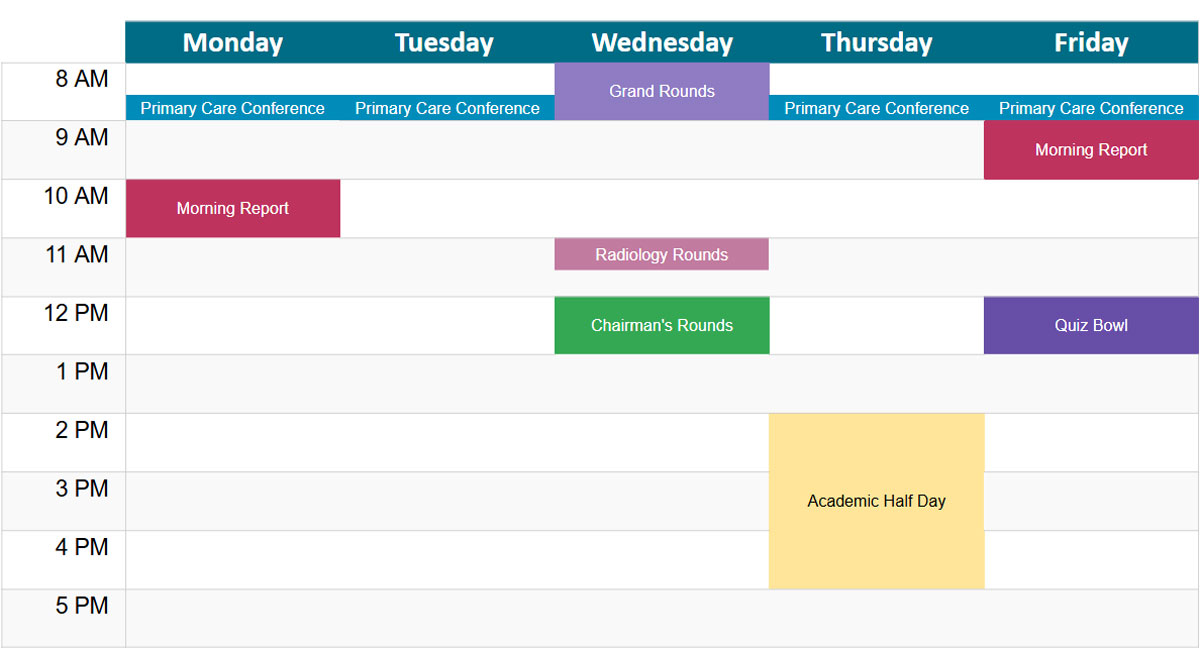
In addition to the bedside teaching received on all clinical rotations, resident learning is supplemented with traditional didactic teaching in the form of weekly Grand Rounds, department-wide Chair Rounds and a dedicated three-hour Academic Half Day that serves as protected educational time for all residents each week.
Clinical Experiences
Outpatient Care
The Jacobi Ambulatory Care Pavilion houses the Children's Health Center, which provides comprehensive outpatient pediatric care. Services include a general academic pediatric practice, an adolescent clinic and a full complement of subspecialty clinics including specialized clinics for children with asthma, HIV infected children and teenagers, neurodevelopmental assessment, behavioral management, LGBTQ services and children with obesity.
Continuity Clinic
The primary care experience is a major component of the residency-training program. Residents spend an average of one session per week in the clinic and work with an experienced, passionate core group of outpatient faculty. Attendings and residents work side-by-side, creating an intimate learning environment.
Outpatient Rotations
During outpatient rotations, residents rotate through the various subspecialty clinics and have increased time for continuity clinic. Under the supervision of general pediatricians and subspecialists, residents learn to manage a child's immediate issues and to serve as an advocate for their patients. In addition to learning by direct patient contact, residents receive formal instruction through seminars and case-based conferences led by the attendings. Residents have an opportunity to explore the impact of the social determinants of health and public health issues by spending time with community partners and service agencies in the neighborhood.
Emergency Department
The Jacobi Medical Center's Pediatric Emergency Department is one of the busiest in New York City and is the sole designated Pediatric Level I Trauma Center in the Bronx. The diversity of patients and acuity of illness offer our residents a rich and varied experience. Under the continuous supervision of pediatric emergency medicine-trained physicians and fellows, residents learn to evaluate, stabilize, and manage children with problems ranging from minor to critical. The emphasis is on learning from direct clinical experience, in concert with seminars, hands-on workshops and simulation sessions to hone procedural skills.
Pediatric Inpatient Services
The overarching goal of Jacobi’s pediatrics inpatient experience is to place the pediatric patient at the center of all educational experiences. We strive to maximize not only clinical skills but a comprehensive understanding of the medical, psychosocial and environmental elements that influence pediatric patient health.
Inpatient Unit
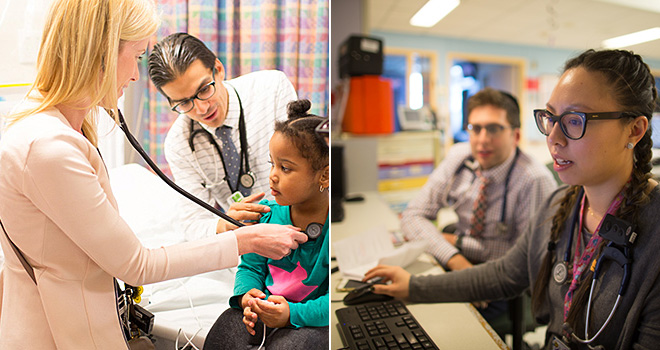
The general inpatient unit is a resident-run service where house staff are the primary providers. Senior residents provide supervision and education to interns and students alike and gain experience in leadership, team building, and clinical decision-making under the guidance and supervision of a pediatrics attending hospitalist. The pediatrics inpatient experience also incorporates bedside teaching rounds with an emphasis on clinical skills, physical exam skills, and clinical reasoning.
Our inpatient education curriculum incorporates dedicated resident education sessions in the form of pediatric SIM cases in coordination with the PICU, pediatric radiology rounds, and morning report twice a week. The morning report sessions promote resident involvement in their own education along with incorporating pediatric hospitalist and subspecialty input and review of literature relevant to pediatric inpatient topics.
Pediatric Intensive Care Unit (PICU)
The PICU is a multi-disciplinary service staffed by board-certified pediatric intensivists, nurse practitioners, physician assistants, and house staff. Residents provide direct patient care and learn to manage critically ill patients under attending supervision.
Neonatal Intensive Care Unit (NICU)
Our 31-bed Level III NICU is staffed by a team of nurse practitioners, physician assistants, residents and attending physicians. Residents attend deliveries and manage a wide variety of neonates from critically-ill preterm infants to stable “feeder-growers,” all under the close supervision of board-certified neonatologists. Education in the NICU involves a combination of bedside teaching, formal lectures, participation in OB/peds case conferences and hands-on NRP review sessions.
Partnerships
Children's Hospital at Montefiore
As our sister hospital and the other teaching hospital for the Albert Einstein College of Medicine, the Children’s Hospital at Montefiore offers Jacobi residents the opportunity to spend several months rotating through subspecialties such as Cardiology and Neurology. As the only free-standing children’s hospital in the Bronx, CHAM is a wonderful resource for our residents in their second and third years.
Memorial Sloan Kettering Cancer Center
Memorial Sloan Kettering Cancer Center — the world’s oldest and largest private cancer center and one of 52 National Cancer Institute-designated Comprehensive Cancer Centers — offers our residents the opportunity to rotate through their Pediatric units during their PGY2 year. Alongside outstanding physicians and scientists, Jacobi residents spend at least 2 weeks working at this world-class institution and oftentimes opt to return for more rotations during their elective time.